Rebirthday
The Rebirthday Ceremony carries a dual meaning — symbolizing both the rebirth of Myal and the personal spiritual rebirth experienced through sacred transformation. It is the reawakening of ancestral knowledge, ceremonial practice, communal memory, and spiritual consciousness within the present generation. In this sense, “rebirthday” is not only personal, but collective. It communicates the idea that ancient traditions thought to be silenced, fragmented, or pushed to the margins can return with new life, renewed purpose, and contemporary relevance. The ceremony becomes a declaration of continuity: that the drum still speaks, ancestral memory still survives and the spiritual philosophies carried through Myal practice remain living systems of meaning, healing, protection and community formation.
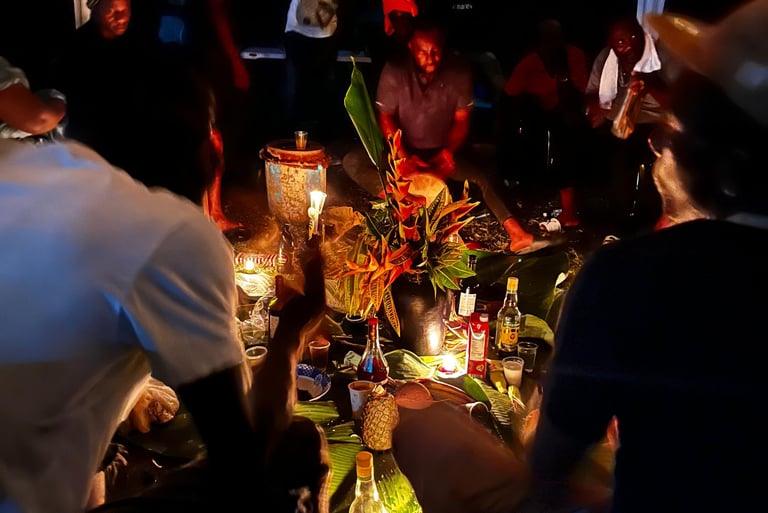
Rebirthday is one of the most widely recognized Myal ceremonies in Jamaica, celebrated under the Maroon Bongo order through Kumina — powerful nkisi associated with healing, protection, prosperity, justice, fertility, victory over evil and transformative life. Held annually on the second Saturday of July, from dusk til dawn, ceremony transforms the area into sacred spaces of power, remembrance, reverence, and community. The ceremony begins with traditional blessings and ritual preparation of the sacred space, where participants gather to honor the bakulu (ancestors) through prayer, song, libation, offerings, fire, and ritual salutes. Participants frequently dress in yellow/gold, white or bandana associated with the nkisi, while some wear symbolic clothing to transmit coded messages. The annual Rebirthday Kumina is a powerful gathering that brings the community together in a shared space of ceremony, cultural continuity and reflection. Through ritual and sacred community we honor the legacy of our ancestors. Centered on ancestral remembrance, renewal, prayer, and community, the ceremony creates a space for spiritual reflection, cultural affirmation, and reconnection with ancestral heritage. More than just music and dance, Rebirthday Kumina is ritual and ceremony and celebrates Kumina as a living tradition that continues to shape community, identity, and collective memory across generations.
The Ceremony
Rebirthday Ceremony is a sacred observance centered on healing, renewal, protection, prosperity, abundance, and spiritual transformation. It commemorates the spiritual “birth” or coming of age, and is a rite of passage in the sacred tradition/ceremonial community. Rebirthday Ceremony is an immersive cultural and spiritual experience that facilitates knowledge transmission of a living tradition through direct participation. Expressed through the Kumina rite, the experience unfolds through drumming, song, dance, libation, invocation, procession, ritual movement, communal response, and sacred acts of blessing and cleansing. Rather than observing from a distance, participants enter an environment where knowledge is carried through rhythm, embodiment, atmosphere, and collective participation. The ceremony centers on prayer, ritual, ancestral remembrance and communal fellowship. Participants gather to honor the ancestors, strengthen cultural ties, and engage in practices that emphasize healing, reflection, and collective connection.
The Orders
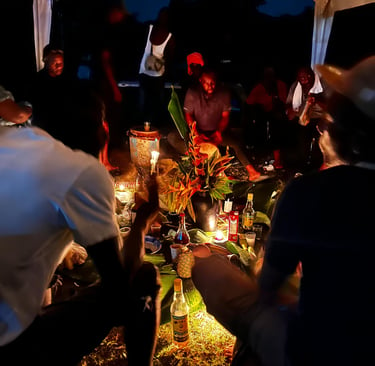
At the heart of the ceremony stands a richly prepared ceremonial altar — a sacred focal point where prayer, offering, ancestral remembrance, and spiritual invocation converge. Adorned with candles, flowers, ritual vessels, sacred seal, offerings, bottles, food, herbs etc, the orders serve as both a spiritual gateway and a living expression of Jamaican Myal cosmology.Every element upon the altar carries symbolic meaning. Colors, objects, scents, foods, and arrangements are carefully chosen to honor specific nkisi and ancestral forces, creating an atmosphere charged with reverence, beauty, rhythm, and spiritual presence. During the ceremony, songs, prayers, libations, drumming, and ritual gestures are directed toward the orders as participants gather around it in collective devotion and celebration.
More than decoration, the orders function as an immersive cultural and spiritual experience — communicating history, philosophy, memory, and sacred relationship through visual symbolism and ceremonial practice. Visitors encounter a living tradition expressed through texture, movement, scent, sound, and sacred artistry, offering a powerful glimpse into the depth, complexity, and vibrancy of Jamaican Myal ceremonial life.
The Fire
The element of fire is another central focus in the ceremony and serves to communicate symbolic meanings to the bakulu. As a spiritual beacon it calls the ancestors and is a signal that communicates the invitation to the ceremony. The sacred fire plays a big role in purification, transformation and spiritual awakening.
Incense
In traditional Myal ceremonial practice, sacred incense from fragrant herbs, barks and tree resins— play a central role in prayer, purification, offering, and communication with the spiritual world. Herbs like Tobacco, Diamba and Tree Resins such as African Frankincense are burned during the ceremony so that its smoke rises upward, carrying prayers, intentions, gratitude, and offerings to the creator of the universe, nkisi, bakulu, and spiritual forces connected to the natural world.
The Feast
The ceremonial feast is an important element that expresses gratitude, reciprocity, abundance, ancestral reverence, and collective unity. Before food is shared among the community, portions must first be presented ceremonially to the nkisi and the ancestors through offerings placed upon the orders. Different nkisi are associated with particular foods, drinks, spices, colors, preparations, and presentation styles, so meals are carefully prepared according to ceremonial protocol and spiritual symbolism.
The feast itself is an immersive sensory experience and a historical culinary journey, where cuisine becomes more than just nourishment — it becomes an archive of the people. Through the feast, participants not only eat traditional dishes; they taste history, witness memory, and take part in the continued survival of ancestral knowledge. Each ingredient, cooking method, offering, and shared plate becomes a way of learning how Myal communities preserved identity, spirituality, resilience, and collective belonging across generations.
Within the ceremonial feast, the ingredients themselves tell the story of cultural encounter, survival, migration, and memory across centuries. The cuisine reflects the blending of Indigenous Caribbean and African influences that together shaped Jamaican society and spiritual life. In this sense, every dish becomes a historical map carried through food. Ingredients such as cassava, maize, peppers, sweet potato, and certain herbal preparations trace back to the agricultural knowledge of Indigenous Caribbean peoples. Cassava and Sweet Potato in particular were foundational staples long before colonization and remains deeply tied to Caribbean ancestral food traditions through breads, and other preparations still used today. Other core ingredients — rice and certain spices — reflect the influence of African food systems as legacies of the Transatlantic era. Certain cooking methods also preserve historical memory. Slow communal cooking over outdoor fires, soups, the use of iron pots, shared serving practices, smoked foods, and heavily seasoned dishes reflect traditions adapted within Maroon communities and rural tribal life. These methods reveal how people transformed limited resources into sustaining cultural systems rooted in cooperation and resilience.
The feast therefore educates participants by revealing how history survives materially through cuisine. The dishes communicate stories of Indigenous agriculture, African retention, colonial violence, resistance, adaptation, trade, migration, and spiritual continuity. Participants come to understand that the food before them is not accidental — it is the result of generations of people preserving memory through cultivation, preparation, ritual, and shared communal life.
Importance of the Ceremony
As an educational experience, the ceremony offers experiential engagement with African and Indigenous-Caribbean cultural continuity, and ancestral knowledge systems through lived practice rather than lecture alone. The gathering creates opportunities to understand ceremonial protocol, symbolism, music traditions, relational values, and the cultural logic embedded within Jamaican Traditional Religion through Kumina rites. Through participation, observation, and guided interaction, attendees gain insight into how ritual functions as a vessel for identity, healing, intergenerational knowledge transfer, and collective belonging.
As an immersive cultural educational experience, the ceremony teaches through participation. Attendees witness how ritual music, movement, offerings, sacred symbols, and communal interaction function together as systems of memory and philosophy. The ceremony communicates that death is not viewed simply as an ending, but as part of an ongoing relationship between generations, ancestors, and community life. Through the rites, knowledge is carried through embodied practice making the celebration both a sacred observance and a living archive of Jamaican spiritual and cultural heritage.
Rebirthday is both spiritual and cultural — a space where tradition, identity, and memory are carried forward through living practice. The ceremony emphasizes continuity between past and present, celebrating resilience, heritage, and the enduring presence of ancestral knowledge within contemporary community life.